


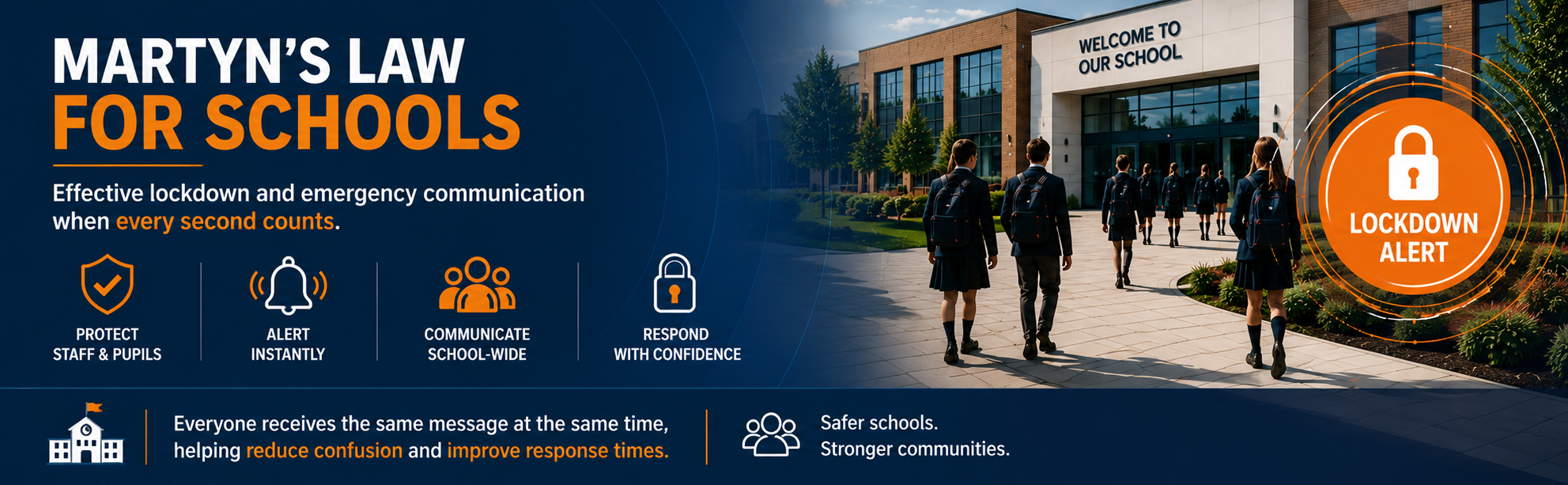
Is Your School Compliant?
Could Your School Communicate a Lockdown Within Seconds?
If a serious incident occurred on your school site today, could you instantly communicate clear instructions to every classroom, office, playground, sports field and visitor?
Following the introduction of Martyn’s Law, schools are being encouraged to review how they would respond to a terrorist threat or other serious security incident. Having a written policy is important, but being able to communicate quickly and effectively during an emergency is critical.
At Schoolwatch, we help schools strengthen their lockdown, evacuation and emergency communication procedures through solutions designed specifically for educational environments.
What is Martyn’s Law?
Martyn’s Law, formally known as the Terrorism (Protection of Premises) Act 2025, was introduced following the tragic Manchester Arena attack in 2017 and the tireless campaign led by Figen Murray, mother of victim Martyn Hett.
The legislation aims to improve public safety by ensuring organisations responsible for publicly accessible premises are better prepared to respond to potential terrorist threats.
Schools are expected to have appropriate procedures in place to:
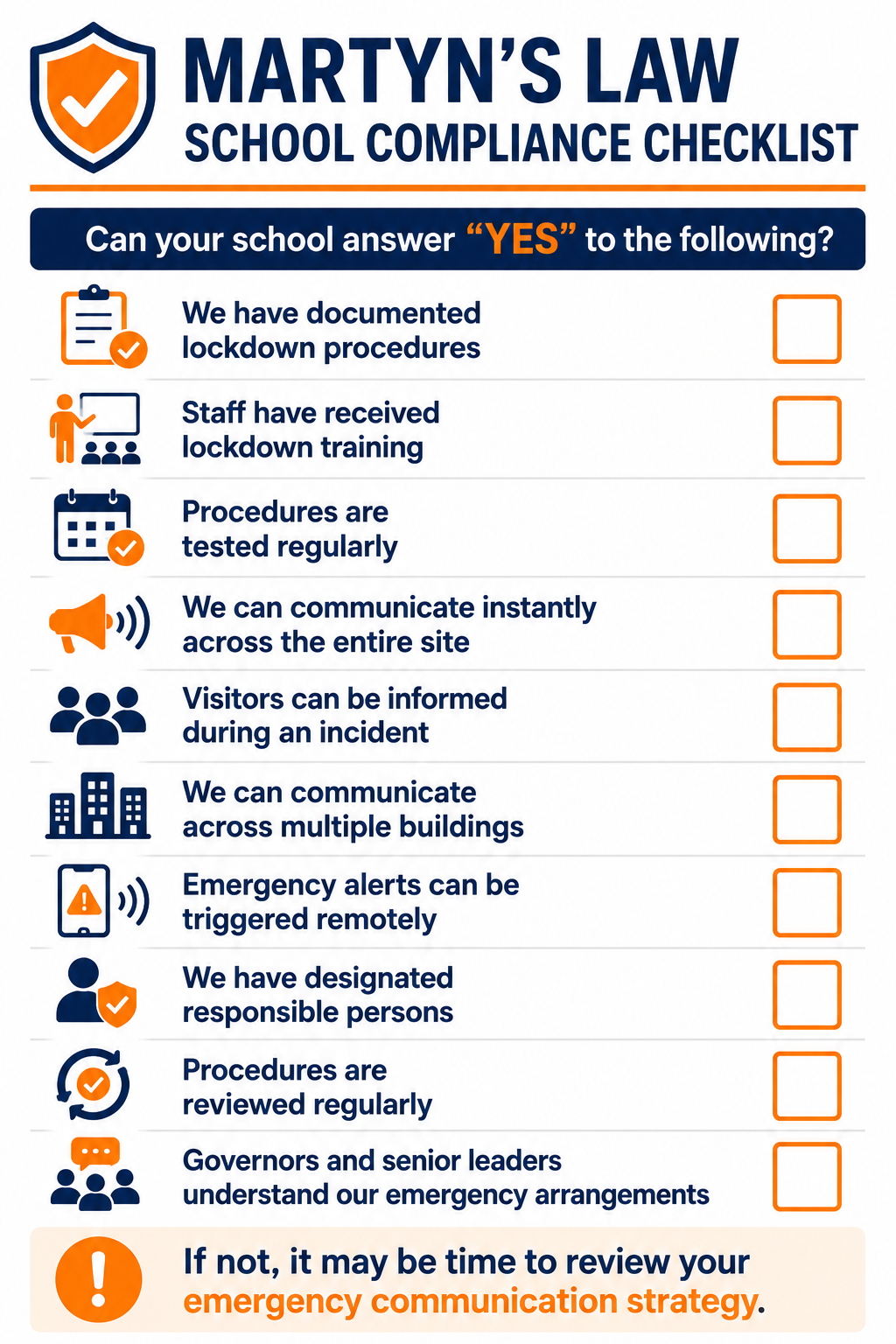
✔ Identify potential risks and vulnerabilities
✔ Respond effectively to an incident
✔ Communicate quickly with staff, pupils and visitors
✔ Provide suitable training and awareness
✔ Regularly review and test emergency procedures
Whilst schools are not expected to implement extensive security measures, they are expected to demonstrate that reasonable and proportionate steps have been taken to prepare for and respond to potential threats.
Unsure whether your current lockdown procedures meet the expectations of Martyn’s Law?
Our team can review your existing arrangements and provide practical recommendations tailored to your school.
What is a School Lockdown Procedure?
A lockdown procedure is a planned response to an incident that requires pupils and staff to remain safely secured within the school or move to designated safe locations.
A lockdown may be triggered by:
- An intruder on site
- A nearby police incident
- Violent or threatening behaviour
- A terrorism-related threat
- Community disturbances
- Dangerous animals entering the grounds
- Gas leaks or hazardous material incidents
- Any situation where movement around the site could place people at risk
When a lockdown is activated, staff and pupils must receive clear and immediate instructions.
Typical actions may include:
- Locking doors and windows
- Closing blinds or curtains
- Turning off lights and interactive displays
- Moving away from windows and doors
- Taking registers
- Remaining silent until further instructions are given
- Maintaining communication with senior leaders and emergency services
The effectiveness of any lockdown procedure depends on how quickly and clearly information can be communicated across the site.
Why Emergency Communication Matters
One of the biggest challenges schools face is ensuring that everyone receives the alert immediately, regardless of where they are on site.
Schoolwatch’s Digital Alerts platform enables schools to:
- Trigger lockdown, evacuation or emergency alerts instantly
- Send notifications across multiple buildings simultaneously
- Broadcast pre-recorded or live announcements
- Alert staff via desktop, mobile app, SMS and digital signage
- Activate alerts remotely from a smartphone, computer or panic button
- Deliver alerts to indoor and outdoor areas
- Track acknowledgements and accountability during an incident
By removing reliance on word-of-mouth communication, schools can significantly reduce response times during a critical event.
The Challenge of Large School Sites
Many schools operate across multiple buildings, sports facilities, temporary classrooms, sixth-form centres and external learning areas.
In an emergency, every second counts.
A lockdown procedure is only effective if everyone receives the message at the same time. Delays of even a few minutes can create confusion and increase risk.
Schoolwatch’s Digital Alerts platform enables schools to communicate across entire campuses from a single activation point, ensuring all areas receive the same message simultaneously.
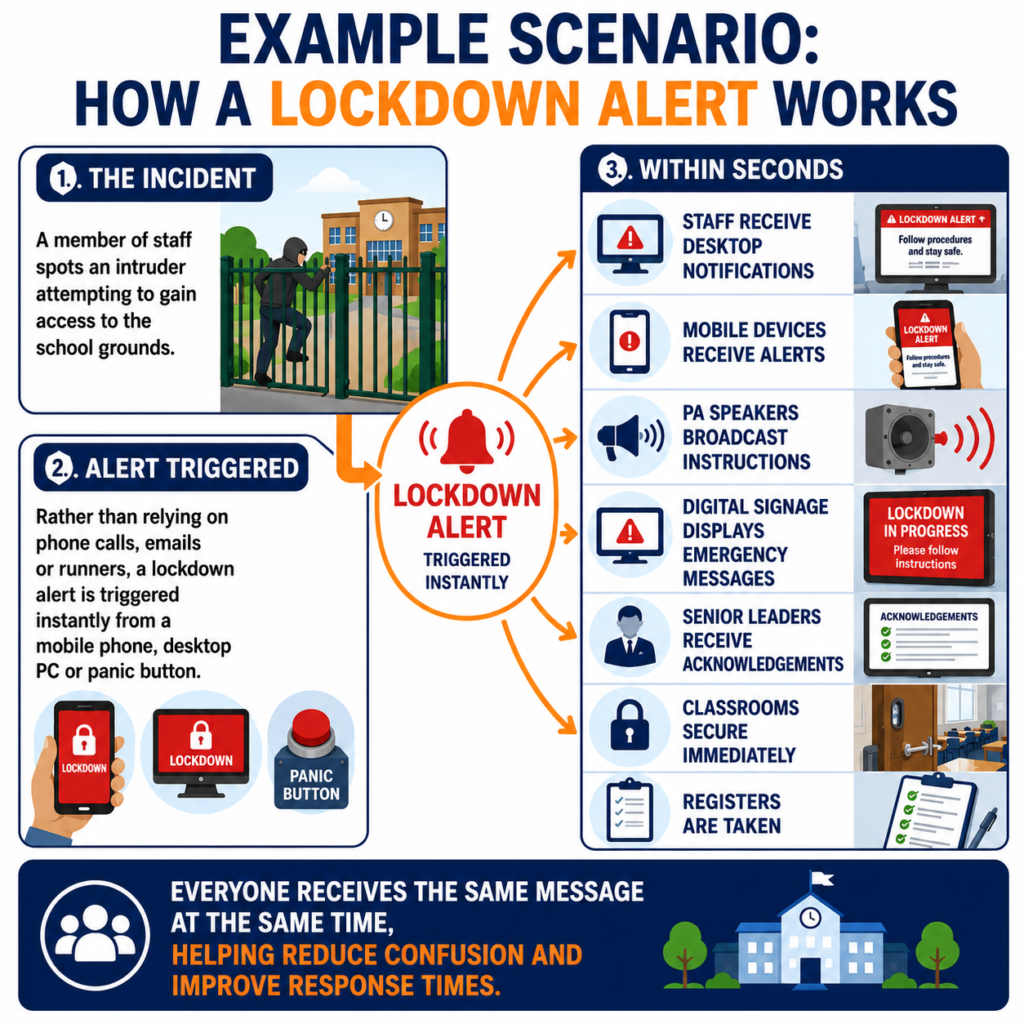
Example Scenario: How a Lockdown Alert Works
Imagine a member of staff spots an intruder attempting to gain access to the school grounds.
Rather than relying on phone calls, emails or runners, a lockdown alert is triggered instantly from a mobile phone, desktop computer or panic button.
Within seconds:
- Staff receive desktop notifications
- Mobile devices receive alerts
- PA speakers broadcast instructions
- Digital signage displays emergency messages
- Senior leaders receive acknowledgements
- Classrooms secure immediately
- Registers are taken
Everyone receives the same message at the same time, helping reduce confusion and improve response times.
How Can Schools Prepare?
Having a written lockdown policy is only the first step.
Schools should regularly review:
- How alerts will be raised
- Who can activate emergency procedures
- How messages will be communicated across the site
- How visitors and contractors will be notified
- How accountability will be managed
- How procedures will be tested and reviewed
Provide Clear Instructions
Ensure all staff understand their responsibilities during a lockdown or evacuation.
Deliver Regular Training
Staff should receive regular refresher training, and procedures should form part of new starter inductions.
Test Procedures
Regular drills help identify weaknesses and build confidence amongst staff and pupils.
Communicate with Parents
Keeping parents informed about your school’s safety measures helps provide reassurance and demonstrates a proactive approach to safeguarding.
Assign Responsibility
Every school should have a designated person responsible for reviewing and maintaining emergency procedures and ensuring compliance requirements are met.
What Does Martyn’s Law Mean for Schools?
Although schools already have safeguarding and emergency planning responsibilities, Martyn’s Law places greater emphasis on preparedness, documented procedures and staff awareness.
Governors, trustees, school leaders and responsible persons should ensure that emergency plans are current, staff are trained, and systems are in place to communicate effectively during an incident.
Schools that can demonstrate robust planning, regular testing and effective communication systems will be in the strongest position to meet their obligations.
Why Schools Choose Schoolwatch
Schools across the UK trust Schoolwatch to help them strengthen safeguarding and emergency preparedness.
Education Specialists
We understand the unique challenges schools face and provide solutions designed specifically for educational environments.
Trusted Technology
Our Digital Alerts platform delivers rapid, reliable communication during lockdowns, evacuations and critical incidents.
Flexible Solutions
Whether you’re a small primary school or a large multi-site academy trust, we can tailor a solution to suit your requirements and budget.
Approved Supplier on the EverythingICT Framework
Schoolwatch is proud to be part of the EverythingICT Framework, giving schools confidence in our products, services and support.
UK-Based Support
Our experienced team provides consultation, installation, training and ongoing support throughout the lifetime of your system.
How Can Schoolwatch Help?
Schoolwatch provides a range of lockdown and emergency communication solutions designed specifically for schools.
Our Digital Alerts platform includes:
- Lockdown Alerts
- Evacuation Alerts
- Mobile Notifications
- Desktop Alerts
- Panic Buttons
- Public Address Integration
- Digital Signage Alerts
- SMS and Voice Notifications
- Acknowledgement Tracking
- Multi-Site Communication
Whether you’re looking for a simple lockdown alert system or a fully integrated emergency communication platform, we can help you find a solution that suits your school’s needs and budget.
Unsure whether your current lockdown procedures meet the expectations of Martyn’s Law?
Our team can review your existing arrangements and provide practical recommendations tailored to your school.